Plan ahead Commercial · Hamilton
Panic & Exit Hardware
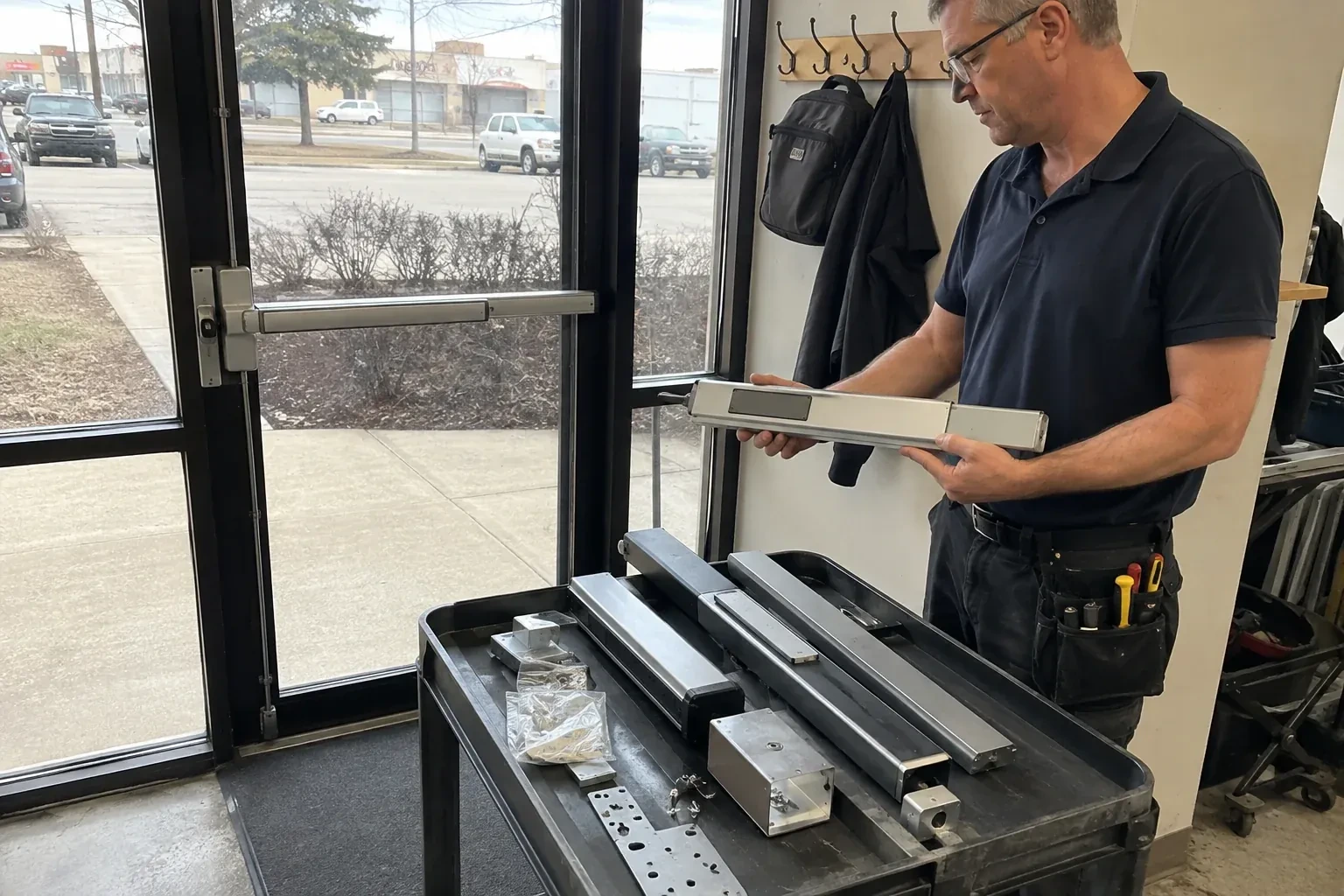
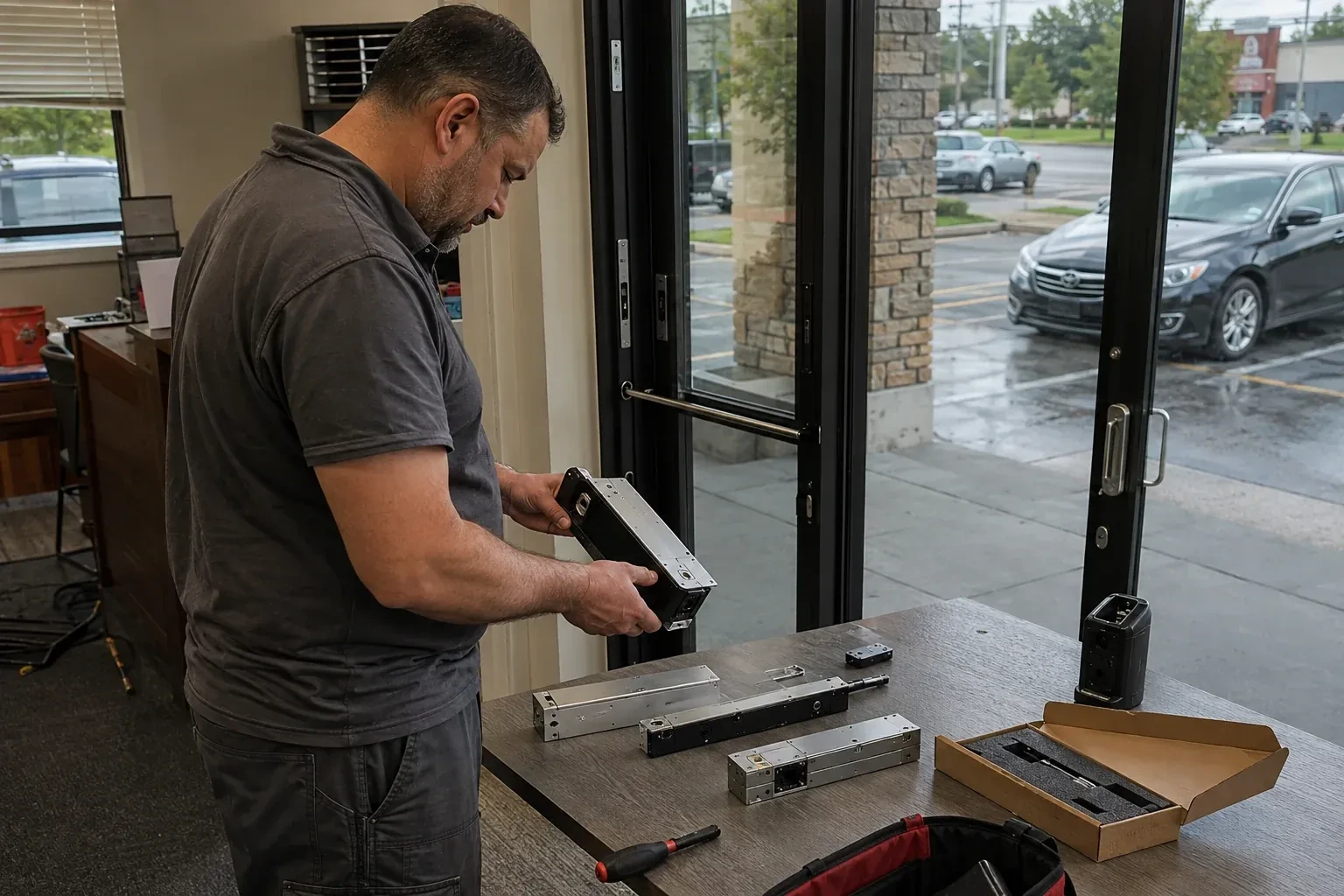
The new access-control reader at the staff entrance works fine going in, but nobody has sorted out the door's exit side, and right now a card reader and a pushbar exist as two separate ideas.
Call now · open 24/7(289) 203-2070In plain words
The visit ends with a record, not just a working door. Every device fitted is logged with its type, its rating, the force and latch checks it passed, and who now holds the dogging key. That record is what a fire inspector, an insurer or a new property manager asks for later, and it is far easier to hand over on the day of installation than to reconstruct afterward from memory of what went on which door.
How the visit goesThe new access-control reader at the staff entrance works fine going in, but nobody has sorted out the door's exit side, and right now a card reader and a pushbar exist as two separate ideas.
Panic & Exit Hardware · Hamilton
How the visit goes
- 1
How the space is actually used day to day
Beyond the code question, the locksmith asks how people actually move through the door: whether it is propped open during business hours, whether deliveries come through it, whether staff dog it open for a shift and forget to release it afterward. These habits shape which options make sense, such as a keyed dogging cylinder that limits who can hold the door open, or an alarm module that tells staff the moment a door meant to stay closed has been used.
- 2
Labelling, signage and the dogging key
Any signage the opening needs, such as a label identifying the door as an exit or noting an alarm, is fitted alongside the hardware rather than left for later. Where the device carries a dogging function on a standard opening, the key or keyed cylinder for it is handed to whoever the building's management names as responsible, along with an explanation of when dogging is appropriate; on any door that sits in a fire separation, mechanical dogging is left off the device entirely and is never installed as a management choice.
- 3
Electrified functions folded into the building's other systems
Any request-to-exit signal, latch retraction or alarm added during the visit now does its own specific job rather than one combined function: an alarm module can sound locally on its own power the moment the crossbar is used, latch retraction lets an authorized signal release the latch for entry, and a request-to-exit signal tells the access-control panel that the pushpad was actuated. None of them alone proves who passed through or from which side, and the exit function itself remains entirely mechanical underneath, so a power interruption still leaves the door able to be pushed open by hand from the inside.
In the van
- Request-to-exit switch
- Installation template and jig
- Through-fixings and mounting hardware
- Outside trim (pull, lever or cylinder)
- Strike and reinforcement
What affects the quote
- 1
Access to the opening
A ground-floor commercial door is straightforward to reach. An opening behind scaffolding, up a stairwell with no elevator, or in a space still under active construction takes longer to work at.
- 2
Removing hardware that should not remain
A padlock, hasp or extra deadbolt found on the door is removed and the resulting holes are filled or covered as part of the same visit, which is its own small task in the quote.
- 3
Number of openings involved
One door with a single device is the simplest case. A building with several affected exits, such as doors from a stairway plus an assembly-room exit, is quoted as the sum of each opening's own work.
Same fees day, night or weekend.
Panic & Exit Hardware: questions
Can one visit cover several doors in the same building?
Yes, and it is common. A building rarely has only one exit affected by an occupant-load or fire-rating question; stairway doors, assembly-room exits and any doors altered together during a renovation are usually assessed and fitted in the same visit, with one written record covering every device installed across the building.
What happens with a pair of doors instead of one?
It depends on the pair. Some latch independently and need nothing extra. Where the hardware calls for a set closing order, a coordinator lets the two leaves close in the right sequence, letting the active leaf's device seat properly into a strike carried on the inactive leaf, or into an astragal. Alternatively, the centre mullion can be removed and a vertical-rod device fitted to each leaf, turning the pair into one wide exit. Whichever applies, both leaves are tested working together, not one at a time.
Can the door be alarmed without making it hard to open?
Yes. An exit alarm module sounds when the device is used, which tells staff a door meant to stay closed has been opened, but it does not add any resistance to the push that releases the latch. The alarm is a notification layer on top of hardware that still opens under one motion, which is why it suits stockroom, dock or perimeter doors where entry through that opening should be rare.
Panic & Exit Hardware near you
Hamilton, Ontario
Hamilton information
- Town
- Hamilton, Ontario
- In business
- 22 years
- Hours
- Open 24/7 · nights, weekends and holidays, same fees
- Phone
- (289) 203-2070
- Visits
- On-site assessment preferred. Request a visit or call.
What the census means at the door
61%
Older homes. About 61% of homes in Hamilton were built in 1980 or earlier, according to the 2021 Census.
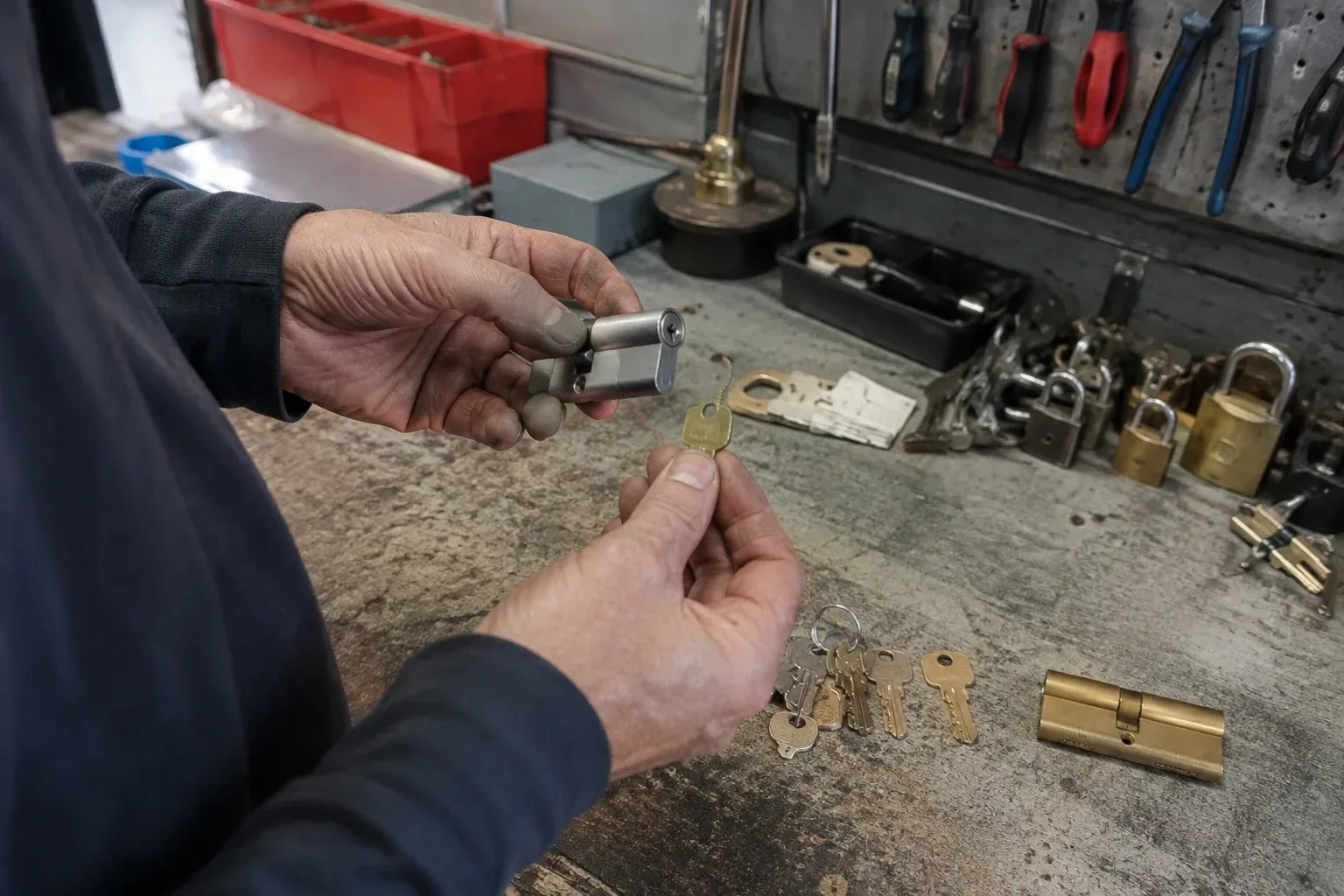
Old brass keys wear thin, and a key that has bent for years finally lets go in a cold cylinder. In older housing stock this is a regular call, so the locksmith is ready to extract the piece, check the cylinder and cut a new key from the code.
56%
A mix of homes. Single-detached houses make up about 56% of homes in Hamilton (2021 Census).
Where houses and attached homes share an area, lockouts are as varied as the doors. A porch, a hallway or a shared vestibule each calls for a slightly different approach, and a locksmith used to all three arrives ready for whichever it is.
Nearby
Open 24/7
Request a visit
The new access-control reader at the staff entrance works fine going in, but nobody has sorted out the door's exit side, and right now a card reader and a pushbar exist as two separate ideas.
Call now · open 24/7(289) 203-2070- On-site assessment preferred
- Same fees day, night or weekend
- 22 years in business